
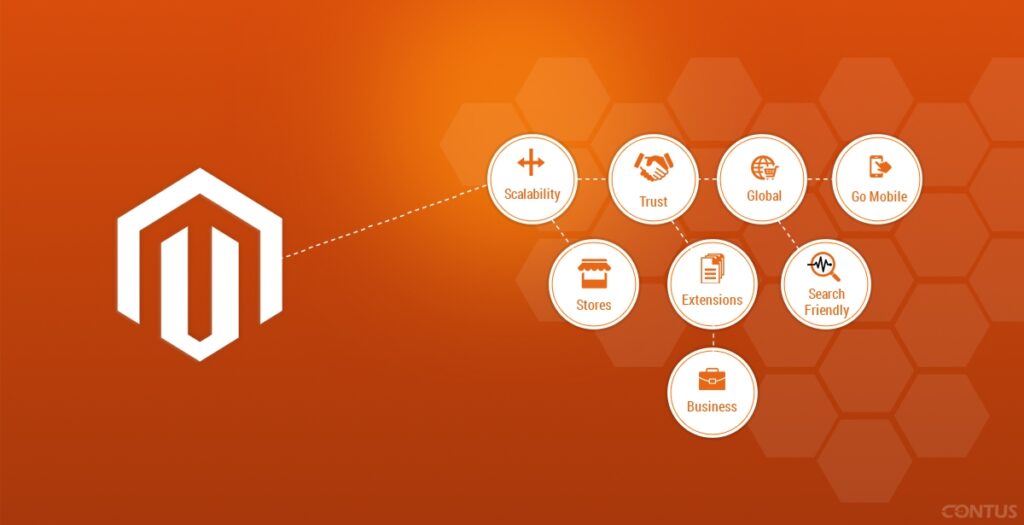
A few months ago, Magento was praised as the most fantastic e-commerce platform for corporations and rapidly expanding online companies by Business News Daily, and we couldn’t agree more.
Today’s e-commerce industry is a fast-paced, ever-evolving landscape where the agile prosper. Where Magento shines is in this situation. As the most adaptable and feature-rich e-commerce software available, Magento is the backbone of 25% of all E-commerce sites globally. This is no surprise, given that Magento can handle any company.
Fast expansion in the e-commerce sector necessitates expanding operations online if companies want to keep up with customer demand and boost their bottom line. So, building a solid architecture that can accommodate the next generation of conversion-boosting website features is important. Site visitors should be guided via a seamless buyer’s experience that ultimately results in a closed deal.
Why Choose Magento for e-commerce Website Development?
Websites built using Magento have access to a wide variety of customizable options. Furthermore, it is expandable, allowing for more features and the ability to accommodate a larger user base. In addition, it has a reputation for being a straightforward, user-friendly answer to the needs of the enterprise. Last but not least, Magento is a powerful system that provides leeway in the design of the user interface and the website’s overall aesthetic.
We’ll explore the advantages of using Magento to build an e-commerce platform
- Open-Source and Adaptability
Corporations need a framework that is adaptable enough to add new features with little programming effort. The framework may be modified to fit the requirements of your company. With just a little tweaking, you can give your website all the bells and whistles it needs, including cutting-edge methods of operation.
Magento is a free, open-source framework, and its modules allow designers and programmers to make their adjustments to the Magento installation. You may use it to plan and improve the website’s procedures essential to boosting conversions. Furthermore, you may use the services of the top eCommerce website development firm to build the greatest website possible for your company.
- Feature-packed choice.
When building an online store with Magento, you may choose various options depending on your needs. Magento is straightforward and flexible, allowing for more effective catalog administration. For example, you may have varied pricing for distinct categories of clients. There are also digital product and sample development tools, attribute setting tools, and sophisticated stock management tools available.
Magento’s layered navigation and catalog filtering tools make it easier for customers to peruse items in various categories. You may construct customizable search items utilizing auto-suggested terms. You may also have enhanced product browsing features that enable you to verify stock availability. The checkout page may be modified to allow for various shipping addresses, payment processors, and the storage of credit card information for later use.
You may take advantage of aided shopping, invoicing options, and call center orders. In addition to helping companies meet local regulations, it accommodates varying tax rates and currencies. It’s compatible with mobile commerce and can easily connect to Google Analytics to provide in-depth insights into customer behavior. Furthermore, it may be used to set up automatic email reminders and dynamic rule-based product relationships.
- Quite scalable.
Due to Magento’s scalability and compatibility with a wide range of mobile devices, it can accommodate many users who are all making purchases simultaneously. Thus, it is one of the finest choices for startups expecting quick expansion. More than that, it works with a wide variety of browsers.
Time will be on the side of your company. A rise in demand may need rethinking product specifications, reevaluating pricing, and retooling support services. Magento can accommodate thousands of product variants and thousands of orders per hour. It can also provide usable interfaces with third-party software in various domains.
- Friendly Search Engine Optimization (SEO)
All websites must be optimized for search engines. For a site to do well in a keyword search, its underlying framework should provide strong support for relevant elements. Magento’s built-in SEO capabilities include editable meta tags and descriptions, keyword and URL choices, and more.
Catalog and product pages in Magento may use SEO-friendly meta tags with ease. Product and catalog URLs are easily adjustable and may be generated on the fly. Also, you may improve the website’s SEO by using alt attributes for photos.
Sitemaps in many formats (HTML and XML), canonical tags, and rich snippets are all possible with Magento. In addition to making Google AdWords easier to execute, it also aids in optimizing for voice search. You may also adjust the navigation settings to your liking. It can regulate the indexing of your site and check for duplicate material.
- Convenience
The extensive library of customizable extensions created by the worldwide community makes Magento eCommerce Website Development a breeze for developers. This facilitates query processing and other essentially static activities. Additionally, HTML5 may be supported to enhance the mobile buying experience.
Magento also benefits from a large international user base who share and expand their expertise via collaborative efforts. Developer, blogger, programmer, etc., communities have the know-how to resolve any difficulties with the site or guarantee that they are fixed correctly. The group discusses and shares information about the newest solutions and industry developments.
- Security
Like many other options, Magento has robust security safeguards to keep your website safe. Security threats are reduced thanks to these built-in safeguards. To restrict access to the admin area to just authorized users, the current version of Magento must be used in conjunction with the two-factor authentication extension. The developers may also choose their URL for the control panel’s administration area.
It employs the SHA-256 hashing technique and better password management tools. Site-wide password policies might be implemented to safeguard information. In addition to automatically setting file system permissions, Magento may restrict user access to vital file systems. Companies may also use unmasking mechanisms to limit who can access sensitive information.
- Improved Efficiency
Magento allows organizations to build eCommerce platforms and adjust them to best meet their needs. Incorporating many internet shops into a single business may greatly expand its customer base. Cloud hosting is a low-cost alternative that helps cut down on upkeep expenses. It’s simple to combine with other tools to boost website functionality.
With Magento, page load times are decreased, and companies can use various extensions to create a unique online presence. The website is swift and safe, thanks to the efficient shipping and transaction processes. The platform uses a Return Merchandise Authorization (RMA) mechanism to facilitate the speedy exchange of unwanted purchases.
- Methods of Payment
When designing an e-commerce website, it is essential to have many payment options for the convenience of your clients. PayPal, Authorize.net, Google Checkout, Amazon Payment, Bank Transfer, Cash on Delivery, and a plethora of additional payment options are all supported by Magento. If feasible, always allow consumers several payment alternatives on your online business so that your customers may make online purchases without any problem.
- Members of the Magento Community
There is a large group of people that work on Magento full time. Software engineers have the option of contacting other members of the community for help if they run into problems. More than 360,000 forum users are involved with the community; they are well qualified to offer suitable instructions and remedies for a particular issue. Users get consistent informational updates from the Magento community about the most recent fashions and technologies.
10. Third-party integration
You can easily include several external functions into your online store using Magento’s framework. Integration of payment processing, database software, shipping, tracking, receiving systems, etc. You can easily track your website’s performance thanks to the platform’s integration with Google resources like Google Analytics, Google Checkout, and Google Base.
Administration of a Network of Sites
It’s wise to set up an online shopping portal with many storefronts. Magento may be the most acceptable option if you want to implement a full-scale multistore strategy for your online business. Many e-commerce enterprises use Magento because of its ease of setting up and administering many web stores from a centralized control panel. The ability to easily add items to many different shops at once is a huge time saver and a huge help when finding practical solutions for building websites.
Due to the ever-increasing popularity of online shopping worldwide, every company must consider opening its online store. Magento, Shopify, WooCommerce, and many more are just a few examples of the many excellent e-commerce web development platforms available today.
Magento is an all-inclusive platform for creating a functional and attractive online store. Using tools like the Magento debugger, EcomDev PHP unit, simple temple route indications, multistore search fields, and more, an e-commerce development firm may build a fantastic online store. These wonderful capabilities and many more characteristics of Magento inspire e-commerce enterprises to select Magento over alternative e-commerce development platforms.